


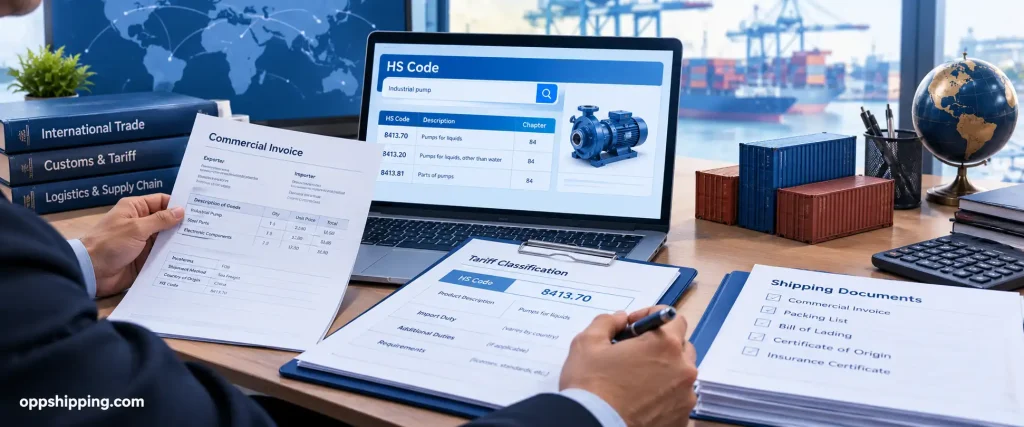
In international trade, correctly identifying goods is one of the most important steps before importing or exporting products. Goods must be classified under the appropriate customs tariff heading based on their technical specifications, material composition, function, and other relevant characteristics. This classification is based on the Harmonized System Code, commonly known as the HS Code.
The HS Code can affect customs duties, import requirements, permits, trade restrictions, and customs clearance procedures. Incorrect classification may result in additional inspections, reassessment of duties, requests for supporting documents, clearance delays, or other legal consequences.
For importers, exporters, purchasing managers, trading companies, and international logistics professionals, identifying the correct HS Code before placing an order or shipping a consignment is essential.
In this guide, we explain what an HS Code is, how its structure works, how to find the correct code for a product, which sources to use for verification, and how accurate tariff classification can support better import cost planning and international shipping operations.
What Is an HS Code?
HS Code stands for Harmonized System Code. It refers to the international product classification system developed by the World Customs Organization (WCO).
The Harmonized System provides a common framework for classifying traded goods. Customs authorities and businesses use it to identify products, support tariff administration, compile international trade statistics, and implement relevant customs regulations.
At the international level, the HS Code consists of six digits. Individual countries may extend this code with additional digits to provide more detailed national classifications for customs, statistical, or regulatory purposes.
As a result, the complete tariff code required for a customs declaration may differ between countries, even when the first six digits are based on the same international HS classification.
An HS Code is therefore more than a product identification number. It is an important part of determining the applicable customs treatment and identifying the requirements that may apply when goods cross international borders.
Why Is the HS Code Important in Import and Export?
Correct tariff classification can influence several stages of an international trade transaction, from purchasing and cost estimation to customs declarations and final delivery.
The main purposes of an HS Code include the following:
- Customs duty assessment: The tariff classification is one of the factors used to determine applicable customs duties.
- Import and export requirements: Certain products may require permits, technical approvals, inspections, or specific documentation.
- Customs declarations: Accurate classification helps ensure that declared goods are consistent with commercial and technical documents.
- Trade restrictions: Some product categories may be subject to restrictions or additional regulatory requirements.
- Trade statistics: HS Codes allow governments and businesses to categorize and analyze international trade flows.
- Import cost planning: Identifying the correct tariff classification helps businesses estimate potential customs costs before purchasing goods.
- Risk reduction: Properly documented classification can reduce the likelihood of disputes, declaration amendments, and avoidable delays.
For companies importing products from China, Turkey, the UAE, or other international markets, checking the tariff classification before finalizing a purchase can help identify potential compliance and cost issues early.
What Is the Difference Between an HS Code and a National Customs Tariff Code?
The terms HS Code, customs tariff code, and tariff classification are often used interchangeably. However, they do not always refer to exactly the same level of classification.
The international HS system provides a common six-digit structure. Countries may extend that structure with additional digits to identify products in greater detail under their national tariff systems.
| Feature | International HS Code | National Tariff Code |
|---|---|---|
| Number of digits | Six digits at the international level | Varies by country |
| Main purpose | Harmonized international product classification | More detailed national classification |
| Application | Identifying internationally recognized product categories | Customs declarations and national tariff administration |
| Consistency between countries | Common six-digit basis | Additional digits may differ |
| Customs duty determination | Not always sufficient on its own | Used with the applicable national tariff and regulations |
Important: If a foreign supplier provides a six-digit HS Code, do not automatically assume that it is sufficient for an import declaration in the destination country. The applicable national tariff code, official product description, and current customs regulations must also be checked.
How Is an HS Code Structured?
The Harmonized System follows a hierarchical structure consisting of sections, chapters, headings, and subheadings. Each level provides a more detailed classification of goods.
Example of a Six-Digit HS Code
Consider the following example:
0807.20
- 08: The first two digits identify the chapter.
- 0807: The first four digits identify the heading.
- 0807.20: All six digits identify the international HS subheading.
In the international HS nomenclature, code 0807.20 covers papayas. This example illustrates how the code is structured; it does not replace checking the applicable national tariff classification.
1. The First Two Digits: Chapter
The first two digits identify the chapter in which a product is classified. Chapters group goods according to their general nature or characteristics.
2. The First Four Digits: Heading
The first four digits identify a more specific product category within the relevant chapter.
3. The First Six Digits: International Subheading
The complete six-digit code identifies a more detailed category within the internationally harmonized system.
4. Additional Digits: National Classification
Countries may add digits after the international six-digit code to distinguish products further, support statistical reporting, or administer national customs requirements.
The number and meaning of these additional digits are not necessarily the same in every country.
When checking a product’s tariff classification, it is important to establish whether the code refers to the international HS nomenclature or a country’s national tariff schedule.

How to Find the Correct HS Code for Your Product
Finding the correct HS Code requires more than searching for a product name online. A reliable classification process starts with accurate product information and continues with verification against official tariff sources.
The following steps can help importers and exporters identify the appropriate classification.
Step 1: Gather Detailed Product Specifications
Before searching for a tariff code, collect the technical information needed to identify the product accurately.
Depending on the type of goods, relevant information may include:
- Commercial name and technical product name
- Main function and intended use
- Material composition
- Manufacturer, model number, or part number
- Dimensions, capacity, power, or performance specifications
- Processing level or degree of completion
- Condition of the goods, such as raw, processed, assembled, or unassembled
- Composition of mixed or multi-component products
- Country of export and country of import
For example, the description “industrial part” is generally too broad to establish a precise classification. Knowing what the component does, which machine it belongs to, and what it is made of can help narrow down the possible tariff headings.
Step 2: Use Relevant Search Terms
Use several descriptive terms rather than relying on a generic product name.
Useful search terms may include:
- The product’s technical name
- The English name of the product or component
- The material or substance from which it is made
- Its main function or application
- The manufacturer’s model or part number
- Descriptions of its composition, processing, or operating principle
For example, when searching for an industrial pump, the type of pump, its operating principle, and its intended application may be more useful than simply searching for “pump HS Code.”
Step 3: Identify Potential Codes from Reliable Sources
After conducting an initial search, you may find several potentially relevant tariff headings. Compare their official descriptions and review the legal notes applicable to the relevant section and chapter.
Useful sources include:
- The official customs tariff schedule of the importing country
- Official trade and customs information systems
- World Customs Organization resources on HS classification
- Relevant customs classification decisions and technical documentation
The World Customs Organization provides resources for understanding the international HS framework. However, the final classification required for an import declaration must be verified against the applicable national tariff and regulations.
Step 4: Compare the Official Description with Your Product
Do not select a tariff code simply because its description sounds similar to the product’s commercial name.
Instead, examine whether the official description and applicable legal notes match the actual characteristics of the goods.
Consider the following questions:
- Does the tariff heading cover the product’s actual material and nature?
- Is the product’s function relevant to its classification?
- Are there special rules for parts, machinery, or composite goods?
- Is the product imported complete, incomplete, assembled, or unassembled?
- Do any section or chapter notes exclude the product from the proposed heading?
The General Rules for the Interpretation of the Harmonized System and the relevant legal notes are essential parts of tariff classification. Search engine results alone are not sufficient for a reliable customs declaration.
Step 5: Verify the National Code and Current Import Requirements
Once you have identified the likely six-digit HS Code, check the corresponding national tariff classification in the destination country.
You should also investigate:
- The official description of the national tariff subheading
- Applicable customs duties and taxes
- Import restrictions and permit requirements
- Mandatory standards or inspection requirements, where relevant
- Special conditions related to the country of origin or the customs procedure
This verification should ideally be completed before the purchase is finalized and before the goods are shipped. Early checks help businesses estimate costs and identify potential compliance issues before the shipment is in transit.
Step 6: Document Your Classification Decision
For high-value goods, regulated products, or items with ambiguous classifications, keep a record of the information used to support the decision.
Useful records may include:
- Product catalogs and technical specifications
- Product photographs
- Material composition information
- The tariff headings considered
- Relevant legal notes and classification references
- Responses from qualified customs professionals or competent authorities
If several tariff codes appear plausible, consult a customs classification specialist or the relevant authority. Where appropriate, consider whether an official classification decision or advance ruling is available.
Best Websites and Sources for HS Code Lookup
The most suitable source depends on whether you need an initial search, information about the international HS structure, or confirmation of the national code.
1. World Customs Organization (WCO)
The WCO is the international organization responsible for developing and maintaining the Harmonized System.
Its resources are useful for understanding HS classification, international nomenclature, and the principles governing the classification of goods.
Best for: Understanding the international HS framework and classification rules.
Visit the official WCO Harmonized System page
2. World Trade Organization (WTO)
The WTO provides information about international trade and the role of standardized product classification in global commerce.
Its resources can help businesses understand the broader relationship between tariff classification and international trade.
Best for: General information about international trade and trade policy.
Visit the official WTO website
3. Official Customs Authorities in the Importing Country
For goods imported into Iran, the national tariff schedule and current customs regulations are essential sources for verifying the applicable classification.
The international six-digit HS Code should be matched against the relevant national tariff subheading and any applicable regulatory requirements.
Check the current tariff schedule, official product descriptions, customs duties, permits, and possible restrictions.
Visit the Islamic Republic of Iran Customs Administration
4. International Trade Databases
Some international trade databases allow users to search tariff codes, compare product descriptions, and review trade statistics.
These tools can be useful during preliminary research, but the accuracy, country coverage, and update frequency of each source should be checked.
Best for: Preliminary searches and international trade research.
5. Manufacturer Documentation and Supplier Information
Manufacturer catalogs, technical data sheets, model numbers, material specifications, and product descriptions can provide important evidence for tariff classification.
A supplier’s suggested HS Code is a useful starting point, but it should be independently verified against the actual product characteristics and the
destination country’s tariff rules.
Important: No general-purpose search tool should be treated as the sole authority for a customs declaration. If multiple classifications appear possible, review the legal notes and seek qualified advice when necessary.
What Documents Are Needed to Determine an HS Code?
The documents required depend on the product and the complexity of its classification. The following information is often useful:
| Document or Information | Purpose |
|---|---|
| Proforma or commercial invoice | Identifies the product, seller, transaction value, and description |
| Product catalog | Explains the product’s function, application, and technical characteristics |
| Technical data sheet | Provides material, dimensions, capacity, power, and performance details |
| Product photographs | Helps identify the physical characteristics of the goods |
| Material composition | Supports classification of chemical, mixed, or composite products |
| Model or part number | Helps match the product to manufacturer documentation |
| Product application | Clarifies the function and intended use |
| Packaging and presentation details | Helps establish how the goods are supplied and whether they form a set or assembly |
Not every document is mandatory for every product. The objective is to provide enough reliable information to determine the actual nature of the goods and identify the appropriate tariff heading.
For example, the model number and intended use may be particularly important when classifying a machinery component, while chemical composition and purity may be more relevant for certain raw materials.

How Does the HS Code Affect Import Costs?
One of the main reasons HS Code classification matters is its relationship with customs duties and import requirements.
The tariff code can help determine the applicable customs treatment, but it is only one part of the overall import cost calculation.
Other factors may include:
- Customs value of the goods
- Applicable customs duty rates and taxes
- Country of origin and any applicable preferential treatment
- International freight charges
- Cargo insurance
- Port and terminal charges
- Warehousing and customs clearance costs
- Permits, inspections, and mandatory standards
For a more accurate import cost estimate, first establish the correct tariff classification and verify the current regulations. You can then assess the applicable duties and other transaction-related expenses.
If the wrong code is used, the initial cost estimate may be inaccurate. This can affect the landed cost of the goods, profit margins, pricing decisions, and the overall feasibility of an import transaction.
For this reason, tariff classification should be checked before finalizing an overseas purchase and arranging transportation.
Common Mistakes When Identifying an HS Code
Even when several information sources are available, certain mistakes can lead to incorrect classification.
1. Relying Entirely on the Supplier’s Code
A supplier may provide a code based on the tariff system used in the exporting country. That code may not be sufficient for the destination country’s customs declaration.
Solution: Verify the suggested code against the product specifications and the importing country’s national tariff schedule.
2. Searching Only by the General Product Name
Terms such as “industrial component,” “pump,” “motor,” or “electronic device” may refer to many different products.
Solution: Include technical specifications, materials, intended use, model numbers, and functional characteristics in your research.
3. Using Another Country’s Complete Tariff Code
The national digits used by the exporting country may differ from those used by the importing country.
Solution: Use the international six-digit HS classification as a starting point, then verify the national code in the destination country.
4. Ignoring Legal Classification Notes
The short description of a tariff heading may not provide enough information to determine whether a product belongs in that category.
Solution: Review the relevant General Rules for Interpretation and the applicable section and chapter notes.
5. Using Outdated Information
Tariff schedules and trade regulations can change. Relying on an older classification or duty rate may lead to inaccurate cost estimates or compliance problems.
Solution: Check the current tariff schedule and regulations applicable at the time of importation.
6. Waiting Until Customs Clearance to Check the Code
If classification problems are identified only after a shipment arrives, correcting documents or revising the import plan may become more difficult.
Solution: Review the tariff classification during the purchasing process and before the goods are dispatched.
The Relationship Between HS Codes and International Shipping
An HS Code does not directly determine the transportation method, but accurate product information and an understanding of customs requirements can support better logistics planning.
In international trade, consistency between product descriptions, commercial documents, shipping information, and customs declarations is important. Incomplete technical details or inconsistencies between documents may lead to additional checks and operational delays.
HS Codes and Sea Freight
In sea freight operations, commercial documentation and cargo information should be prepared and coordinated before a vessel departs.
Checking tariff classification early can help identify relevant customs requirements and improve import planning. However, a correct HS Code alone does not guarantee faster clearance; documentation quality, permits, current regulations, and operational conditions also matter.
HS Codes and FCL vs. LCL Shipping
The choice between Full Container Load (FCL) and Less than Container Load (LCL) generally depends on shipment volume, weight, cost, delivery requirements, and operational considerations.
The HS Code alone does not determine which shipping method is most suitable.
However, shipments containing multiple product types may require more detailed item descriptions and separate tariff classifications where applicable. The relevant information should be accurately reflected in the supporting documents.
The Role of an International Freight Forwarder
An international freight forwarding company can help coordinate shipment information, review transportation requirements, arrange logistics, and communicate with the parties involved in moving the cargo.
Where a tariff classification is uncertain or disputed, the final decision should be based on specialist assessment and, where necessary, guidance from the competent customs authority.
Early coordination among the importer, supplier, customs broker, and freight forwarder can help reduce documentation inconsistencies and avoid preventable delays.
Final Checklist Before Placing an Order or Shipping Goods
Before confirming an international purchase or booking transportation, review the following checklist:
The product’s technical specifications, materials, and intended use are clearly documented.
The supplier’s suggested HS Code has been checked against reliable sources.
The national tariff code in the destination country has been verified.
The official tariff description matches the actual product.
The current tariff schedule and applicable regulations have been reviewed.
Applicable customs duties and other relevant import costs have been assessed.
Potential permits, standards, and import restrictions have been identified.
Product information is consistent across the invoice and relevant shipping documents.
Specialist advice has been obtained if the classification remains uncertain.
The information needed to plan shipping, packaging, and delivery is available.
If the tariff classification has not yet been confirmed, it is advisable to complete the review before dispatching the shipment. This can improve cost visibility and reduce the risk of late-stage corrections.
Frequently Asked Questions About HS Codes
An HS Code is an international product classification code. The international HS structure uses six digits, while individual countries may add further digits for national tariff classification.
Start by gathering detailed product specifications. Search reliable classification resources, compare the official descriptions and relevant legal notes, and verify the national tariff code in the importing country.
The international six-digit HS structure provides a common basis for classification. However, the additional national digits and some tariff details may differ. A code used in China should therefore be checked against the requirements applicable in Iran.
A product name can help with preliminary research, but it is not always enough. Materials, technical characteristics, intended use, composition, and the condition of the goods may affect the classification.
Yes. Tariff classification is one of the factors used to determine customs duties and certain import requirements. The total cost also depends on customs value, origin, current regulations, freight, insurance, and other applicable charges.
Depending on the nature of the error and the applicable regulations, incorrect classification may result in additional checks, requests for documentation, amended declarations, reassessment of customs charges, or other legal consequences.
No. Basic classification information and some lookup tools are available publicly. However, access to specialized databases or professional classification advice may involve fees.
Yes. HS Codes are used to classify exported goods and can support customs declarations, trade statistics, and the review of applicable export and destination-country requirements.
The supplier’s code can be a useful starting point, but it should be checked against the actual product specifications and the importing country’s regulations. The accuracy of a customs declaration should not depend solely on the supplier’s suggestion.
A freight forwarder can help coordinate shipment information and documentation and identify relevant operational requirements. Where a classification is uncertain, specialist review and, if necessary, confirmation from the competent customs authority may be required.
Conclusion: Verify the HS Code Before Shipping Your Goods
The HS Code is a key element of international import and export operations. It provides a standardized framework for classifying goods and can influence customs duties, regulatory requirements, documentation, and clearance procedures.
To identify the correct code, do not rely solely on the product’s commercial name or the supplier’s suggestion. Review the technical specifications, compare the official tariff descriptions, verify the national code in the destination country, and seek professional advice if the classification remains uncertain.
For effective international trade planning, tariff verification should be carried out alongside shipping arrangements, cost estimation, document preparation, and delivery scheduling—not after the goods have already arrived at customs.
OPS Shipping supports businesses with international freight coordination and logistics planning. By reviewing cargo information and transportation requirements early, importers and exporters can improve coordination between suppliers, logistics providers, and other parties involved in the supply chain.