


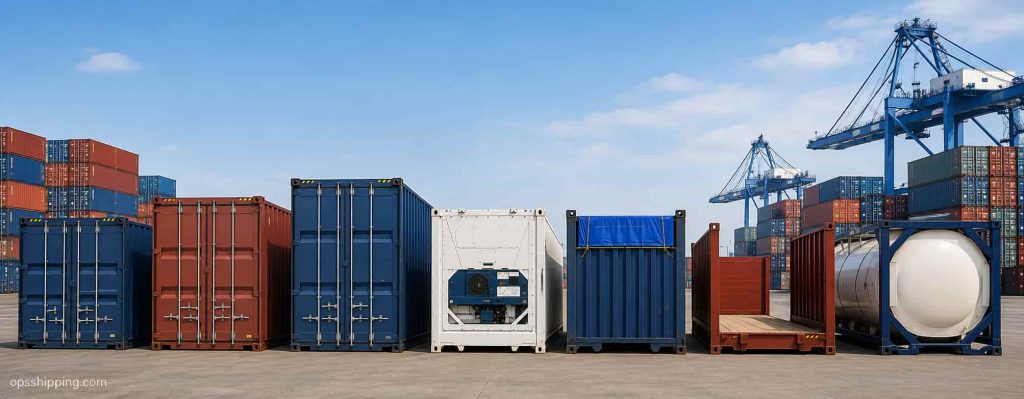
Shipping containers are one of the most important components of international logistics and global trade. They make it possible to move goods safely and efficiently between ports, countries, and different modes of transportation. However, not all containers are designed for the same type of cargo. Depending on the volume, weight, dimensions, nature, and storage requirements of your goods, one container type may be suitable while another may be completely inappropriate.
The most commonly used containers in international sea freight are 20ft and 40ft standard containers. However, there are also specialized options such as 40ft High Cube, Reefer, Open Top, Flat Rack, and Tank Containers, each designed for specific types of cargo. Choosing the right container can directly affect shipping costs, cargo safety, loading procedures, and the overall efficiency of the transportation process.
In simple terms, choosing a container for an import or export shipment is not simply a matter of asking, “Should I use a 20ft or 40ft container?” The correct decision requires an assessment of the cargo’s volume, weight, dimensions, nature, temperature requirements, and loading method.
In this guide, we explain the main types of shipping containers, their applications, advantages, and limitations, and the key factors you should consider before booking your shipment.
If you are not yet familiar with the different transportation methods, we recommend reading “A Comprehensive Guide to Shipping Methods from China to Iran“ to understand the differences between sea freight, land transportation, air freight, FCL, and LCL.
What Is a Shipping Container?
A shipping container is a standardized and durable cargo unit designed to transport goods throughout the international supply chain. One of its biggest advantages is that it can be transferred between different modes of transportation without requiring the cargo itself to be unloaded and repacked.
For example, a container can be transported by truck from a supplier’s warehouse to a port, loaded onto a vessel, and later transferred to another truck or train at the destination. The goods remain inside the same container throughout these stages, which reduces unnecessary handling and improves cargo security.
The standardized dimensions of shipping containers also allow ports, vessels, trucks, trains, and handling equipment in different countries to work together efficiently. This standardization is one of the main reasons containerization has become the foundation of modern international trade.
However, containers differ in size, construction, equipment, and intended use. A standard dry container may be suitable for general cargo, while temperature-sensitive products may require a Reefer container, and oversized machinery may require an Open Top or Flat Rack container.
What Are the Main Types of Shipping Containers?
Shipping containers can generally be classified into several major categories based on their size, structure, and application.
The most common types include:
- 20ft Standard Container
- 40ft Standard Container
- 40ft High Cube Container
- Reefer Container
- Open Top Container
- Flat Rack Container
- Tank Container
- Specialized Containers for Specific Cargo
The availability of each container type can vary depending on the shipping line, origin and destination ports, trade route, and type of cargo.

What Is a 20ft Shipping Container?
A 20ft Dry Container is one of the most widely used container types for general cargo. It is particularly suitable for shipments where the weight of the cargo is relatively high compared with its overall volume.
A standard 20ft container typically provides around 33 cubic meters of internal volume, although the exact capacity may vary depending on the container model and manufacturer.
20ft containers are commonly used for industrial equipment, spare parts, raw materials, packaged products, machinery components, and many other types of general cargo.
One of the main advantages of a 20ft container is that it can be a practical choice for relatively heavy cargo that does not require a large amount of space. Therefore, when deciding between a 20ft and 40ft container, you should consider not only the volume of your cargo but also its total weight and the applicable weight restrictions along the shipping route.
What Is a 40ft Shipping Container?
A 40ft container is another standard option widely used in international sea freight. It provides significantly more cargo space than a 20ft container and is generally suitable for larger-volume shipments.
A standard 40ft container typically offers around 67 cubic meters of internal volume, although actual usable capacity depends on the container’s design and the way the cargo is packed and loaded.
This type of container is commonly used for bulky commercial goods, manufactured products, packaged goods, furniture, consumer products, and other cargo requiring more space.
However, having twice the length of a 20ft container does not necessarily mean that a 40ft container can always carry twice as much usable cargo. The dimensions of individual packages, cargo weight, loading configuration, and shipping regulations all need to be considered.

What Is a 40ft High Cube Container?
A 40ft High Cube Container is similar to a standard 40ft container in length and width, but it has greater internal height. This additional height provides more internal volume, making the container particularly useful for bulky but relatively lightweight cargo.
High Cube containers are commonly used for goods such as plastic products, furniture, packaging materials, machinery components, and other products that require additional vertical space.
For example, if your cargo takes up a large amount of space but does not reach the maximum allowable weight, a High Cube container may allow you to use the available volume more efficiently.
However, High Cube is not automatically the best option for every shipment. If the cargo is already close to the weight limit, the additional volume may provide little practical benefit. Therefore, both cargo volume and cargo weight should be considered before selecting this type of container.

What Is a Reefer Container?
A Reefer Container, short for refrigerated container, is designed to transport goods that require controlled temperature conditions during transportation.
These containers are equipped with refrigeration and temperature-control systems and are commonly used for products such as food, meat, seafood, fruits, vegetables, certain pharmaceuticals, and other temperature-sensitive goods.
The cost of using a Reefer container is generally higher than that of a standard dry container because the shipment requires specialized equipment and continuous temperature management throughout transportation.
Before booking a Reefer container, the required temperature range should be clearly identified. It is also important to determine whether the cargo requires refrigeration, freezing, controlled humidity, or another specific environmental condition.
What Is an Open Top Container?
An Open Top Container is designed for cargo that cannot easily be loaded through the standard container doors because of its height, shape, or dimensions.
Unlike a conventional dry container, an Open Top container does not have a fixed solid roof. This allows cargo to be loaded from above using cranes or other lifting equipment. After loading, the top can be covered with an appropriate protective tarpaulin or cover.
Open Top containers are often used for:
- Industrial machinery
- Large equipment
- Heavy components
- Construction materials
- Tall cargo
- Oversized items
The main advantage of an Open Top container is its flexibility during loading. However, the cargo must still comply with the applicable weight, height, and transportation requirements.
What Is a Flat Rack Container?
A Flat Rack Container is a specialized container designed for heavy, wide, tall, or oversized cargo that cannot be accommodated inside a standard enclosed container.
Depending on the specific model, Flat Rack containers may have fixed or collapsible end walls while the sides are largely open. This structure allows large cargo to extend beyond the normal dimensions of a standard container when permitted by the applicable shipping regulations.
Flat Rack containers are commonly used for:
- Heavy machinery
- Industrial equipment
- Construction equipment
- Large tanks
- Project cargo
- Oversized components
Because these shipments often involve non-standard dimensions and high weights, proper cargo securing and loading procedures are essential. The cargo must be properly lashed and secured to prevent movement during transportation.
What Is a Tank Container?
A Tank Container is a specialized container designed for transporting liquids, gases, and certain chemical or industrial materials.
Instead of having an enclosed cargo space like a standard dry container, a Tank Container consists of a tank mounted inside a standardized protective frame. This allows it to be handled and transported using standard container-handling equipment.
Tank Containers can be used for certain chemicals, industrial liquids, oils, and liquid food products. However, the type of material, tank specifications, safety requirements, and applicable transportation regulations must always be checked before shipment.
For hazardous materials, additional regulations and safety procedures may apply. Therefore, the type of substance should be identified before selecting the tank equipment and booking the transportation.
What Is the Difference Between Standard and Specialized Containers?
Standard containers such as 20ft, 40ft, and 40ft High Cube are primarily designed for general cargo. They are suitable for products that do not require special temperature control or unusual loading arrangements.
Specialized containers, on the other hand, are designed to address specific cargo requirements. For example:
- Reefer → temperature-sensitive cargo
- Open Top → tall cargo or cargo requiring top loading
- Flat Rack → heavy or oversized cargo
- Tank Container → liquids and certain specialized materials
- High Cube → bulky cargo requiring additional internal height
This is why container selection should begin with an analysis of the cargo rather than simply choosing the cheapest available container.
Shipping Container Types Comparison Table
| Container Type | Main Application | Suitable For |
|---|---|---|
| 20ft Standard | General cargo | Medium-volume and relatively heavy shipments |
| 40ft Standard | General cargo | Larger-volume shipments |
| 40ft High Cube | Bulky cargo | Lightweight, high-volume goods |
| Reefer | Temperature-controlled transportation | Food and temperature-sensitive products |
| Open Top | Top loading | Machinery and oversized/tall cargo |
| Flat Rack | Oversized and heavy cargo | Industrial and project equipment |
| Tank Container | Liquid and specialized cargo | Chemicals and industrial liquids |
This table provides a general overview. In actual shipping operations, the appropriate container must be selected according to the specific characteristics of the cargo and the requirements of the shipping route.
What Are the Dimensions and Capacity of Shipping Containers?
Container capacity is one of the most important factors when selecting equipment for an international shipment. Standard 20ft and 40ft containers are among the most widely used options for general cargo, while High Cube containers provide additional internal volume.
As a general reference, a standard 20ft container provides approximately 33 cubic meters of internal volume, while a standard 40ft container provides approximately 67 cubic meters. A 40ft High Cube container provides additional internal volume because of its greater height.
However, these figures do not mean that the entire internal volume can always be filled with cargo. Packaging dimensions, gaps between packages, loading arrangements, pallet configuration, and weight restrictions can all reduce the practical usable capacity.
How Are Container Types Related to FCL and LCL?
An important point that is sometimes misunderstood is that container type and shipping method are not the same thing.
FCL and LCL describe how the available container space is used, while 20ft, 40ft, High Cube, Reefer, and other models describe the type of container or equipment being used.
With FCL (Full Container Load), the container is dedicated to one customer’s shipment. Depending on the cargo, this may involve a standard container, High Cube, Reefer, or another specialized container.
With LCL (Less than Container Load), cargo from multiple customers is consolidated into a shared container. Each customer pays for the space occupied by their own shipment rather than booking the entire container.
Understanding this distinction is important because choosing between FCL and LCL is a separate decision from choosing the appropriate container equipment.
If you want to better understand the differences between these two shipping methods and how they affect shipping costs, transit time, and container utilization, we recommend reading our guide to FCL vs. LCL: What Is the Difference?.
How Do You Choose the Right Shipping Container?
Choosing the right container should not be based solely on the volume of the cargo. The first step is to identify the cargo’s volume, weight, dimensions, nature, packaging, and handling requirements.
For example, a shipment may be relatively light but extremely bulky, making a 40ft High Cube container more suitable. On the other hand, a heavy but compact shipment may be better suited to a 20ft container.
If the cargo is temperature-sensitive, a Reefer container may be necessary. If the cargo is oversized or cannot be loaded through standard container doors, an Open Top or Flat Rack may be more appropriate.
The shipping route is another important factor. Not every shipping line offers every type of container on every trade route. Container availability, equipment positioning, port facilities, and shipping line policies can therefore influence the final choice.
Before booking, it is recommended to check the cargo specifications together with the available equipment and the conditions of the selected shipping route.
Common Mistakes When Choosing a Shipping Container
One of the most common mistakes importers make is selecting a container based only on the estimated volume of their cargo. A shipment may technically fit within a container’s volume but still exceed weight restrictions or be impossible to load efficiently because of the dimensions of individual packages.
Another common mistake is ignoring cargo packaging and loading configuration. Two shipments with exactly the same total CBM can require different amounts of container space depending on the shape, dimensions, and packaging of the individual items.
Importers also sometimes compare only the basic ocean freight rate. However, the total cost of using a particular container can also involve terminal charges, handling, loading and unloading services, specialized equipment costs, and other logistics expenses.
Therefore, comparing the total landed transportation cost is usually more useful than comparing the basic ocean freight rate alone.
Which Container Is Best for Imports from China?
There is no single container type that can be considered the best option for every shipment from China. The appropriate choice depends on the type of goods, total volume, weight, dimensions, packaging, temperature requirements, and shipping budget.
For general packaged goods, 20ft and 40ft standard containers are among the most common choices. If the shipment is bulky but relatively lightweight, a 40ft High Cube may provide better space utilization. Temperature-sensitive products may require a Reefer, while oversized machinery or project cargo may require an Open Top or Flat Rack.
For this reason, importers should provide complete cargo specifications before booking transportation. This allows the logistics provider to assess not only the appropriate container but also the shipping method, route, estimated transit time, and associated costs.
When importing goods from China, choosing the right container is only one part of the shipping process. Factors such as the shipping route, origin and destination ports, transit time, and cargo requirements should also be carefully considered. To better understand the overall process, read our guide to Sea Freight from China to Iran which covers the main routes, shipping procedures, and key considerations for transporting goods from China to Iran.
FAQ
The 20ft and 40ft standard dry containers are among the most commonly used container types for general international cargo. The appropriate size depends on the cargo volume, weight, and loading requirements.
The primary difference is their size and internal capacity. A 40ft container provides considerably more space, while a 20ft container can be a practical option for smaller or heavier shipments that do not require as much volume.
A High Cube container has the same general length and width as a standard container of the same nominal size, but it has greater height. This provides additional internal volume and makes it useful for bulky cargo.
Perishable and temperature-sensitive goods are generally transported using a Reefer container, which provides controlled temperature conditions throughout the transportation process.
Depending on the dimensions and weight of the machinery, an Open Top or Flat Rack container may be suitable. The exact equipment should be selected after reviewing the cargo dimensions, weight, lifting requirements, and loading method.
No. FCL and LCL are shipping methods, not container types. FCL means Full Container Load, while LCL means Less than Container Load. The actual container equipment can be standard, High Cube, Reefer, or another specialized type depending on the cargo and shipping requirements.
Conclusion
Choosing the right shipping container is an important part of international sea freight planning. The correct container can improve cargo safety, optimize available space, reduce unnecessary costs, and make loading and transportation more efficient.
Standard 20ft and 40ft containers are suitable for a large proportion of general cargo, while specialized equipment such as High Cube, Reefer, Open Top, Flat Rack, and Tank Containers is designed to meet more specific cargo requirements.
The most important point is that container selection should never be based solely on cargo volume. Weight, dimensions, cargo type, packaging, loading requirements, route, equipment availability, and additional costs should all be considered before making a final decision.
For importers sourcing goods from China and other international markets, careful container planning before booking transportation can help prevent unnecessary expenses and operational problems later in the supply chain.
Opsshipping Services by OpsShipping
OpsShipping provides international logistics solutions including sea freight, import, export, transit, and Door-to-Door transportation services across major trade routes connecting Iran with countries such as China, Dubai, Turkey, India, and Russia.
Choosing the right container is only one part of a successful international shipment. Route selection, shipping method, cargo consolidation, loading arrangements, shipping line coordination, and destination procedures can all affect the final cost and delivery time.
By reviewing the specifications of your shipment, the OpsShipping team can help identify a suitable transportation solution based on your cargo type, volume, destination, required delivery time, and commercial requirements.
Contact OpsShipping to evaluate the most suitable shipping method and container for your cargo.